
by Patrick Baaklini
An Era of Rising Protectionism
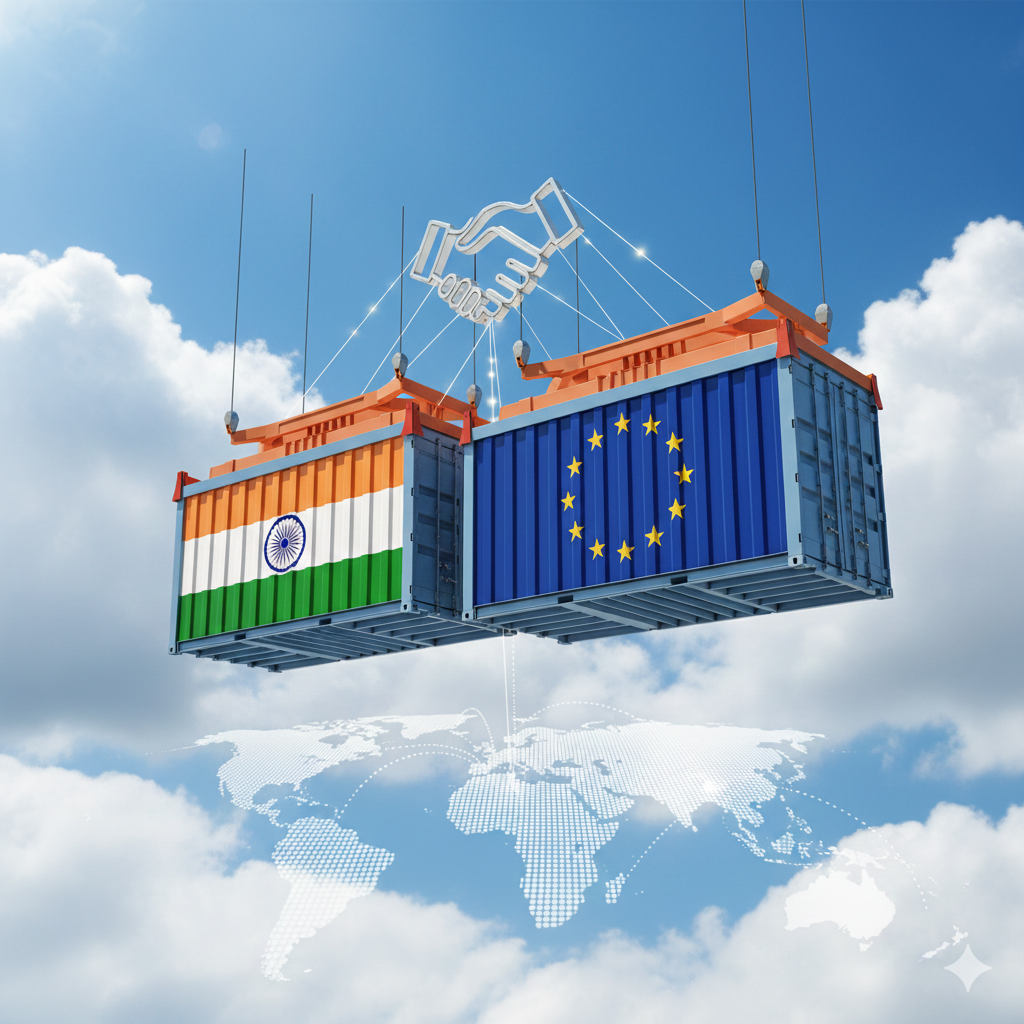
At a time of resurgent protectionism and geopolitical realignment, trade negotiations have become more crucial and more complex than ever. The ongoing negotiations between India and the European Union over a Free Trade Agreement (FTA) offer a compelling case study in modern trade diplomacy, revealing how negotiations are conducted to forge transformative agreements in today’s volatile global economy.
The India–EU FTA: A High-Stakes Negotiation
After nearly two decades of formal talks, India and the EU are now in the final stages of concluding what would be the largest agreement of its kind in the world. With the potential to significantly increase the current value of India–EU trade, estimated at USD 139.75 billion, this agreement carries substantial economic and geopolitical weight.
German Chancellor Friedrich Merz has suggested that such an agreement could be signed as early as the end of January 2026, with European Commission President Ursula von der Leyen and European Council President António Costa expected in New Delhi for the summit on 27 January, underscoring the urgency of the situation.
However, these negotiations expose a fundamental challenge of contemporary trade diplomacy: reconciling divergent economic interests while accommodating deeply entrenched national priorities on both sides.
Core Issues: Carbon, Automobiles, and Compromise
These tensions highlight how environmental policy and commercial interests collide in the 21st century. India insists on preserving the World Trade Organization’s differentiated rules for developing countries and rejects the EU’s proposed carbon border taxes on steel, aluminium, and cement. Meanwhile, disagreements over automobile tariffs, data regulation, and governance continue to hinder progress.
The EU is considering expanding its Carbon Border Adjustment Mechanism (CBAM) to include up to 180 additional downstream products. From 1 February 2027, importers will be required to purchase CBAM certificates for goods brought into the EU during 2026. This measure risks significantly increasing costs for Indian exporters. Indian negotiators must therefore seek transitional arrangements that allow industries time to adapt.
This situation illustrates a classic negotiation dilemma: the EU’s climate objectives clash with India’s need to protect its domestic industries.
Core Principles of Effective Negotiation
Seasoned negotiators in such high-stakes contexts apply several key principles:
Preparation and Strategic Positioning. Negotiators must enter discussions with clear objectives and a defined strategy regarding what can be traded to reach an agreement, while carefully listening to counterparts and identifying areas of convergence or compromise.
Mastering One’s BATNA. The Best Alternative to a Negotiated Agreement represents the most advantageous course of action if negotiations fail. It serves as a benchmark for evaluating proposals and a crucial source of leverage. Both India and the EU understand that walking away would only strengthen protectionist rivals, notably the United States.
Balancing Competition and Cooperation. Negotiators employ a range of strategies—bargaining, reciprocal concessions, and win-win exchanges—to move talks forward and resolve disputes. The India–EU talks exemplify this dynamic: both sides hold firm on core issues while exploring creative compromises on secondary ones.
Managing Domestic Political Constraints. When a partner adopts a rigid position, claiming that a particular outcome is essential for parliamentary approval, it can be difficult to determine whether this reflects a genuine political constraint or a negotiation tactic. Skilled negotiators learn to distinguish true red lines from diplomatic theatre.
The Geopolitical Context: Why This Agreement Matters Now
With projected economic growth of 7.4% for fiscal year 2026, India continues to be the fastest-growing economy among G20 countries. For Europe, the agreement reflects a broader strategy of diversifying trade partnerships beyond the United States and China—two powers that have adopted strongly nationalist trade policies in recent months.
The Road Ahead
The India–EU FTA demonstrates that transformative trade agreements require far more than technical expertise alone. They demand negotiators who understand not only tariff schedules and regulatory harmonisation, but also the psychological, cultural, and political dimensions of international negotiation. The ability to reshape counterparts’ perceptions of their own interests and to turn concessions into strategic gains is what ultimately distinguishes successful negotiations from failed ones.
As the India–EU dossier approaches its conclusion, it offers valuable lessons for professionals navigating the interconnected world of international business and diplomacy.