
Four decades of negotiations: the taste for discovery
· Articles, News in brief · 3 min read
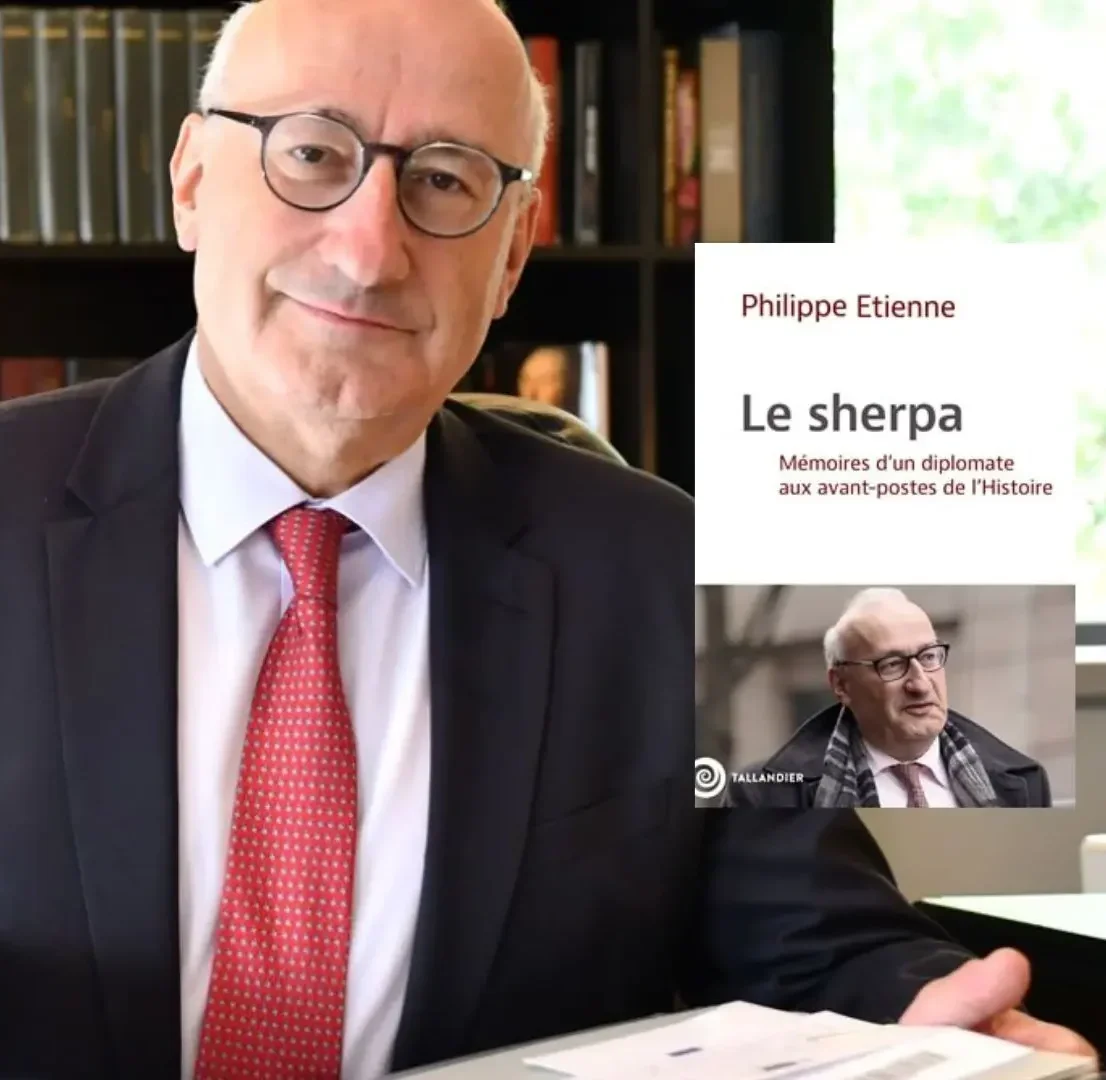
Written by Philippe Etienne (Consultant Trainer),
Under the title “Le Sherpa”, Philippe Etienne publishes his Mémoires d’un diplomate aux avant-postes de l’Histoire (memoirs of a diplomat on the front lines of history), which takes us on a journey through French diplomacy of the last forty years.
Times are very turbulent, and yet our author, a former French ambassador to the United States and diplomatic adviser to Emmanuel Macron from 2017 to 2019, keeps his calm and composure, which is what strikes you most when reading the book. Do not look in it for the “punchline” that will create buzz; that is not the style of the house.
The life of a diplomat is an entire life as a negotiator. The book demonstrates this constantly. One of the qualities of a negotiator is being able to look at a situation from the other person’s point of view in order to understand what drives it. To practise this discipline, Philippe Etienne draws on his love of languages. He obviously speaks English, but he is also fluent in German, and his command of Serbo-Croatian and Romanian commands respect.
This ability and this taste for discovering the other run through the whole book. The author tells us, in fact, that before starting his career, he had gone on a two-month bike ride in 1977 with friends, from Vienna to Warsaw, via Hungary and Czechoslovakia:
“I see the division of Europe at the time, since I am crossing it.”
Faith in Europe
Philippe Etienne is a convinced, fervent European. As half of his years in diplomacy were devoted to Germany and the European Union, he hopes that his memoirs can “provide keys to understanding the relationship between France and its first partner, which was also its main adversary for three quarters of a century”.
He allows us to dive into “the inner workings of European negotiations”, whose technical appearance can be off-putting. His successive postings at the Permanent Representation of France to the European Union led him to devote an entire chapter to “the Europe of everyday life”: for example, the negotiation on a “chocolate directive” protecting quality products against pressure from the United Kingdom, which wanted to label as “chocolate” products containing fats other than cocoa butter.
Philippe Etienne also held several posts with our ministers for European Affairs and for Foreign Affairs. He notably assisted with, and contributed to, the setting up of a great concrete success of the EU, the Erasmus programme. A few years later, alongside Bernard Kouchner, he succeeded the phlegmatic character played by Niels Arestrup in the film Quai d’Orsay, based on the comic book of the same name.
With Putin, Trump, Macron: a front-row view of essential relationships
The pages devoted to Putin’s Russia, “the cold-blooded tsar”, as well as to Donald Trump’s America and, of course, to his work alongside Emmanuel Macron, hold the attention.
Philippe Etienne met the “Wizard of the Kremlin”, whose real name is Vladislav Surkov, for an exchange on Ukraine in 2014: “a meeting that amounts to a monologue”. Enough to make one greatly regret Boris Nemtsov, assassinated in 2015, described as an “anti-Putin”: someone who rejected the idea that democracy is incompatible with Russia and saw in Putin’s regime a betrayal of the hopes born from the end of the USSR.
On Emmanuel Macron, described as “fast”, “demanding” and even “approachable”, Philippe Etienne confides: “I find it hard to understand the feeling of remoteness or superiority that is attributed to him, a feeling that the polls seem to confirm. That is not the person I experience internally.”
Concerning the American president, Philippe Etienne avoids painting a direct portrait.
He is more interested in the relationship built with him, notably during his first term, and stresses the “substantial” nature of the exchanges between the two heads of state despite their disagreements.
Finally, he reminds us of a good example to avoid reducing everything to a clash of personalities by recalling the submarine crisis under Joe Biden. A crisis that also illustrates the disappointing side of Europe since, as he writes, “we did not benefit from exemplary solidarity from the other Europeans during this episode”.
In what gallant terms these things are put! Good negotiators avoid words that irritate!