
The “Augmented Negotiator”: How to combine data and strategic empathy
· Articles · 3 min read

In today’s business landscape, negotiation professionals find themselves at a crossroads. On one side, the explosion of data, predictive pricing software and analytical tools offers surgical precision in preparing cases. On the other, relational tensions, organisational complexity and ever more demanding customers remind us that the final decision remains eminently human. The myth of the purely intuitive negotiator is dead, as is that of the fully automated negotiator. The future belongs to the augmented negotiator: the one who knows how to marry the rigour of data with the power of strategic empathy.
The binary trap: when data alone hardens positions
Massive access to data has transformed negotiation preparation. Market analyses, purchasing histories, margin simulations: sales departments and purchasing teams have a formidable analytical arsenal at their disposal. However, relying exclusively on these indicators carries a major risk: reducing negotiation to a simple mathematical balance of power.
- The “zero-sum” illusion: Armed with ultra-precise spreadsheets, negotiators tend to freeze their objectives and to see every concession as a quantified defeat.
- Forgetting the emotional context: Algorithms measure the past and model the probable, but they completely ignore the state of mind, the internal political pressures or the personal uncertainties of the person across the table.
Redefining empathy: from sympathy to tactical tool
Often wrongly confused with complacency or sentimentality, strategic empathy is nothing like naive sentimentalism. In complex negotiation, it is a high-precision diagnostic instrument.
| Classic dimension | Strategic empathy |
|---|---|
| Trying to be likeable in order to please. | Understanding in depth the structure of the other party’s constraints. |
| Avoiding conflict to keep the atmosphere pleasant. | Using tension as a revealer of the real hidden stakes. |
| Guessing intuitively what the customer wants. | Mapping the counterpart’s fears, KPIs and political risks. |
Strategic empathy means putting yourself in the “mental shoes” of the person across the table, in order to understand not only what they are asking for, but why they are asking for it in this precise form.
The winning alliance: delegate the calculation, embody the relationship
To become an augmented negotiator, you need to share out the roles between the technological tool and human intelligence according to their respective strengths:
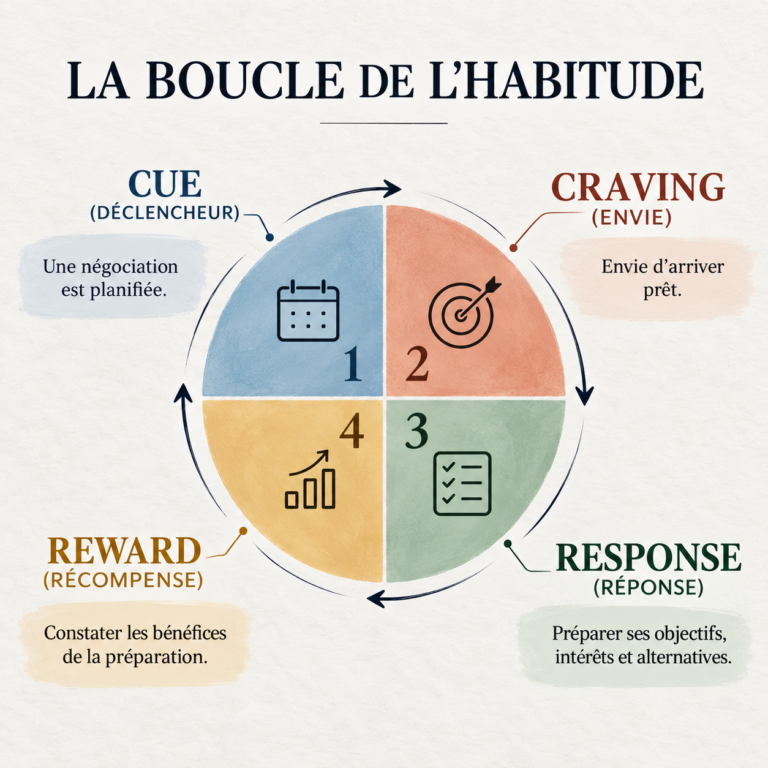
- The preparation phase goes to the machine (Data): Use analytical tools to map out alternative scenarios (fallback options or MESO), identify potential friction points on prices and model your non-negotiable limits. This frees up valuable mental bandwidth.
- The execution phase goes to the human (Empathy): At the table, the challenge is to observe micro-behaviours, listen between the lines, use silence tactically and co-create creative solutions that the software had not anticipated.
Practical case: turning a pricing deadlock around with the data-empathy duo
Imagine a customer who brandishes an automated market analysis to demand a 15 % price reduction. A negotiator stubbornly attached to their price grids will dig in; an overly accommodating negotiator will give way on margins.
The augmented negotiator, by contrast, reacts in two stages:
- Thanks to data: They immediately know that their cost structure does not allow this reduction without compromising service quality, and they identify the volume or timing levers available.
- Thanks to strategic empathy: Rather than curtly rejecting the request, they dig deeper with an open question: “I can see that this threshold is critical for your management committee. Beyond the unit price, what is the overall budget indicator that you absolutely must secure this quarter?”
By shifting the discussion from the raw price to overall performance or risk mitigation, they turn a sterile power struggle into a problem-solving workshop.
In the era of artificial intelligence and big data, the value of a great negotiator no longer lies in the ability to remember figures or to apply rigid price grids. The more analytical tools progress, the more the difference will come from the ability to create connection, to decode people and to build trust where mistrust and algorithms prevail. The augmented negotiator is neither the one who is subjected to technology, nor the one who rejects it: it is the one who uses it to feed an exceptional relational intelligence.