
Preparing for a negotiation: making preparation a professional habit
· Articles, News in brief, Analysis · 4 min read
How can preparation become a systematic practice before every negotiation? James Clear’s work on habits offers an interesting avenue for developing this essential negotiator skill.
In a negotiation training course, you learn to define your objectives, identify your interests, understand those of the other party, assess your alternatives and look for options.
But knowing negotiation techniques is not always enough. You still have to put them to use in practice.
The question then becomes: how can you turn negotiation preparation into a genuine professional habit?
James Clear and Atomic Habits

James Clear is an American author specialising in habits and behavioural change. In Atomic Habits, published in 2018, he puts forward a central idea: lasting progress depends less on exceptional efforts than on small behaviours repeated regularly.
He thus distinguishes between goals and systems.
A goal indicates what you want to achieve. A system is the set of behaviours you put in place to move towards that goal.
Applied to negotiation, “negotiating better” is a goal. Systematically preparing your negotiations is a behaviour that can help achieve it.
The habit loop applied to negotiation
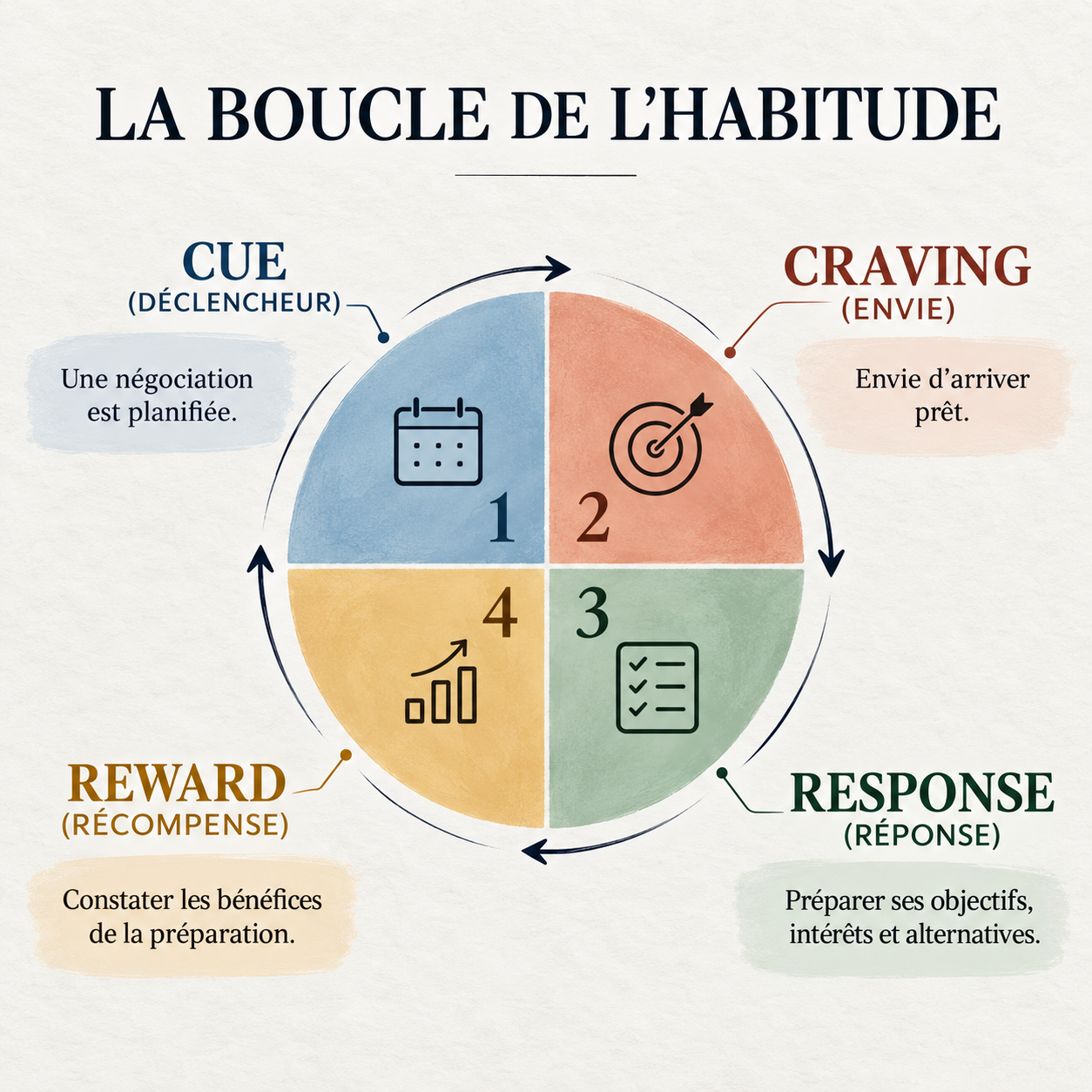
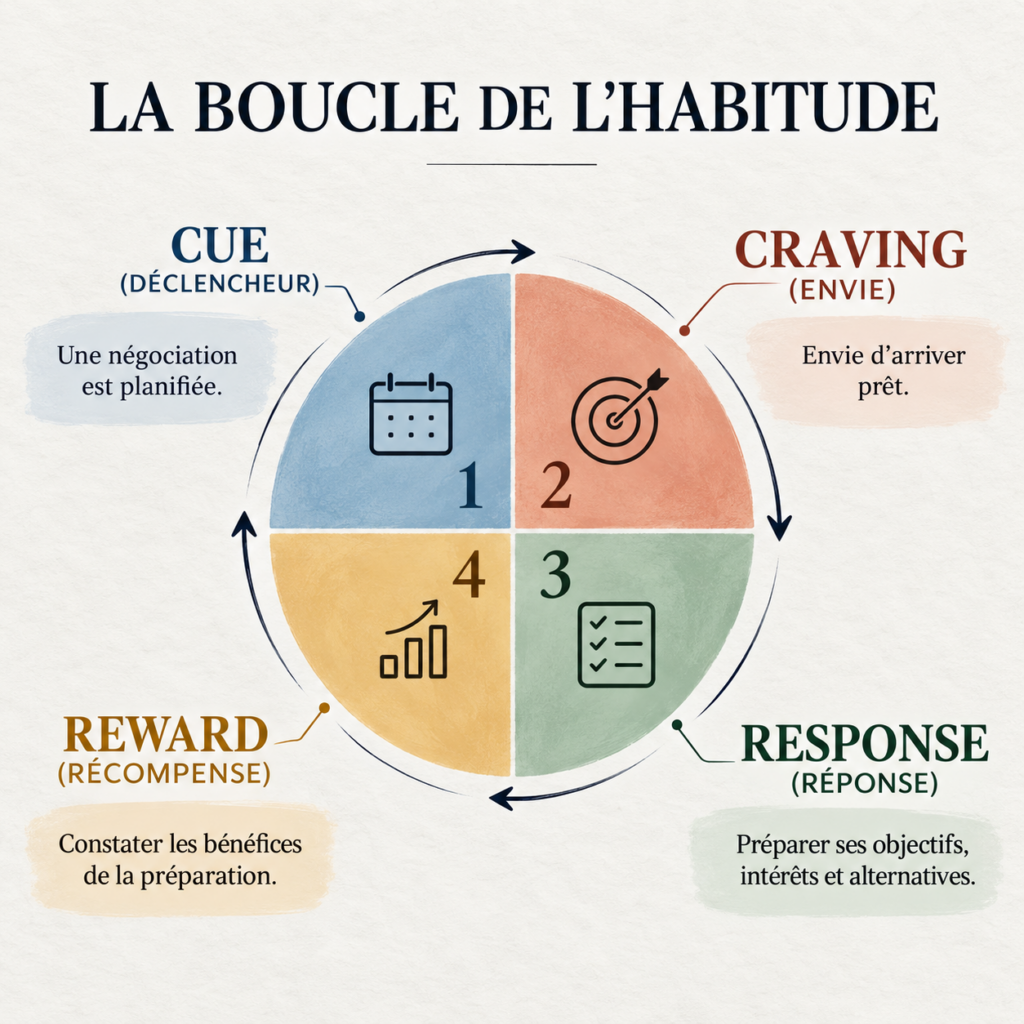
James Clear describes the formation of a habit in four stages:
1. Cue: The trigger
The trigger is what signals that a behaviour should begin.
In a professional context:
A negotiation is scheduled → I start my preparation.
The aim is to create a simple association between the upcoming negotiation and the preparation reflex.
2. Craving: The desire
The trigger takes on meaning because it is associated with a sought-after benefit.
For the negotiator, this may mean wanting to arrive at the discussion with more clarity, perspective and adaptability.
Preparation obviously cannot predict exactly what will happen. It makes it possible to think in advance about what you want to obtain and about the various situations you might face.
3. Response: The response
The response is the behaviour itself: preparing the negotiation.
A few questions can form a first basis:
- What are my objectives and my interests?
- What are my alternatives if no agreement is reached?
- What are the other party’s interests and constraints?
- What information am I missing?
- What options could meet the interests of both parties?
- What questions should I ask during the negotiation?
These questions echo several fundamental principles of principled negotiation, notably the work of Roger Fisher and William Ury on interests, alternatives and the search for mutually satisfying options.
4. Reward: The reward
The last stage is the reward: seeing the benefits of the behaviour.
Good preparation can make it possible to enter the negotiation with a better understanding of the situation, to ask more relevant questions and to adapt better to new information.
After the negotiation, the follow-up session (experience review) strengthens the loop:
What did we anticipate correctly? What did we misunderstand? What should we prepare differently next time?
This gives us a cycle:
Prepare → negotiate → learn → prepare again.
From knowledge to skill
This approach raises an important question for professional negotiation training.
There is a difference between:
“I know that I need to prepare for a negotiation.”
and:
“When a negotiation is scheduled, I automatically start preparing for it.”
The first formulation describes knowledge. The second describes a habit.
This is why preparation deserves to be regarded as a negotiator skill, but also as a practice to be repeated.
Preparation does not need to be long in order to be systematic. A routine negotiation may need a few minutes; a strategic negotiation will naturally call for deeper analysis.
The essential thing is to keep the same reflex:
A negotiation is scheduled → I prepare.
Preparing to adapt better
Preparing for a negotiation does not mean trying to control its course entirely.
A negotiation remains a dynamic situation: information changes, interests may differ from what you imagined and new options may appear.
Preparation must therefore give more freedom, and not lock the negotiator into a predetermined script.
Preparing for a negotiation is not predicting exactly what will happen. It is giving yourself the means to understand better and decide better when the situation changes.
A professional habit
The value of James Clear’s approach for negotiation ultimately lies in this idea: good practices become truly useful when they are repeated.
A negotiation training course can provide the methods and tools. Practice makes it possible to master them. Repetition can then turn them into professional habits.
Making preparation a reflex before every negotiation is thus a simple way to gradually develop your skills as a negotiator.
A negotiation does not begin when the parties sit down around the table. It begins with the preparation that precedes the meeting.
References
James Clear, Atomic Habits: An Easy & Proven Way to Build Good Habits & Break Bad Ones, Avery, 2018.
Roger Fisher, William Ury & Bruce Patton, Getting to Yes: Negotiating Agreement Without Giving In, Penguin Books.