
The Strategic Art of Refusal: Why Saying “NO” Is Your Best Asset in Negotiation
· Feature articles, Brief · 5 min read
In the collective imagination, negotiation is a permanent quest for “yes.” Winning a client’s agreement, getting a budget approved, signing a contract: everything seems to suggest that a good negotiator is one who knows how to get around obstacles to obtain the other party’s approval.
Yet this idyllic view is a trap. Systematically saying “yes” out of fear of conflict or a wish to please leads straight to deadlock, lopsided compromises and professional burnout. Conversely, knowing how to say “no” is one of the most powerful skills, and one of the most underrated, in the modern negotiator’s toolbox.
At CENEGO (European Negotiation Centre), we are convinced that mastering structural refusal radically transforms the dynamics at the negotiating table. Drawing on the essential contributions of William Ury (co-author of the Harvard method and author of The Power of a Positive No), let us explore why and how to say no in order to succeed better.
The Trap of the Complacent “Yes”: Why We Dread Refusing
Why is it so hard to turn down an offer, a last-minute request or an unacceptable condition? The answer lies in human psychology: the fear of confrontation.
We fear that saying “no” will break the relationship, ruffle our counterpart or close the door on any collaboration for good. The result? We opt for a default “yes.” Yet this false agreement causes a double loss:
- For you: An accumulation of frustrations, untenable commitments and a loss of value.
- For the relationship: A latent resentment that ends up exploding when the broken promises resurface.
In a negotiation training course, one of the first tasks is to deconstruct this myth: saying yes to everything is not negotiating, it is capitulating.
The “Positive No”: William Ury’s Conceptual Revolution
In his reference work The Power of a Positive No: How to Say No and Still Get to Yes, William Ury introduces a fundamental paradigm shift: refusal should not be an aggressive rejection, nor a wall built against the other person. It is an instrument of protection and construction.
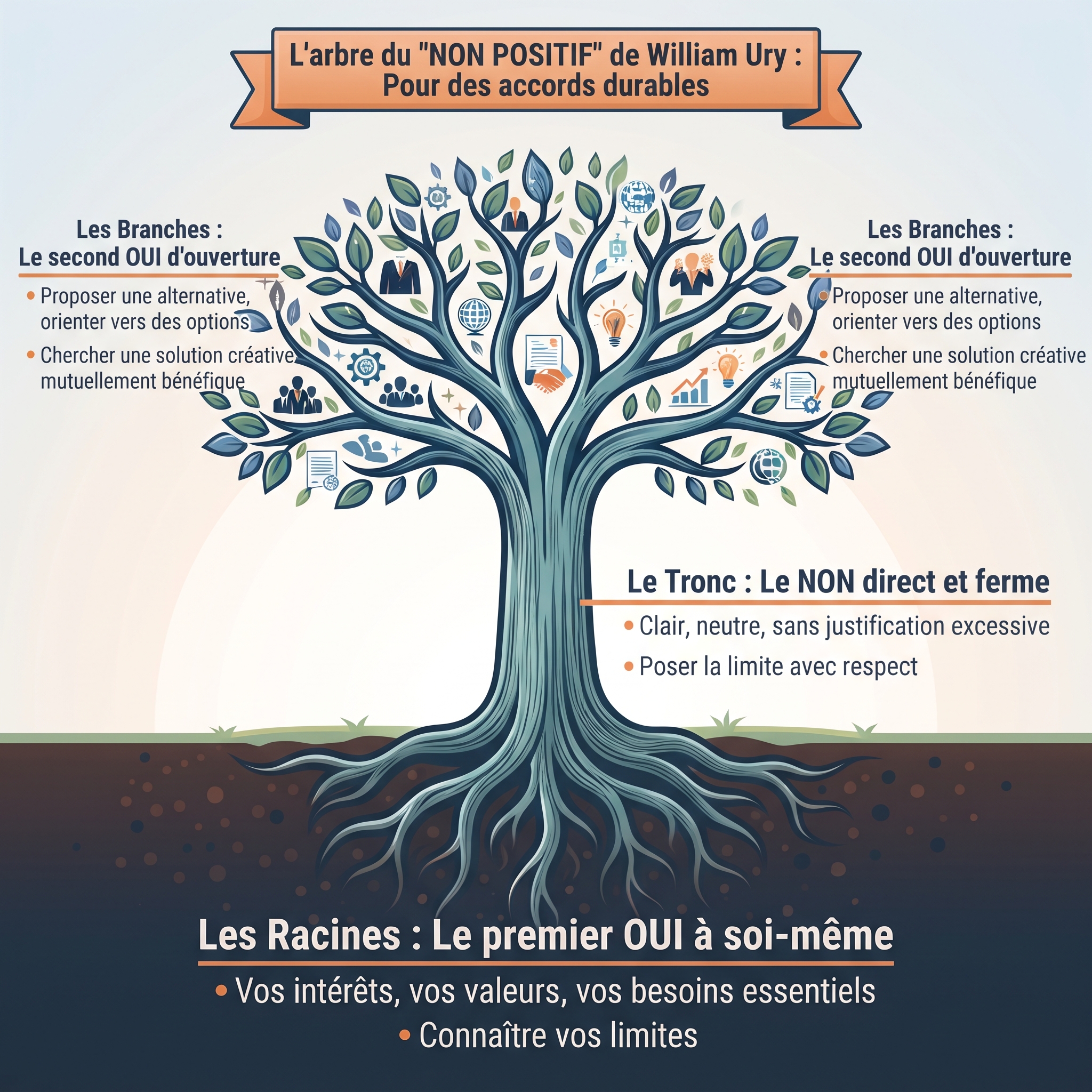
Ury proposes the metaphor of the tree to structure the “Positive No”:
- The Roots (The first “YES”): Before saying no to the other person, you must say yes to your own interests, your values or your limits. Why are you refusing? What are you trying to protect (your profitability, your integrity, your time)? Anchoring your refusal in a positive “yes” gives you the energy and the legitimacy you need.
- The Trunk (The direct, neutral “NO”): The refusal must be clear, without frills or excessive justifications that weaken your position. No evasions: set the limit calmly.
- The Branches (The second “YES” of openness): The no does not end the game, it steers it towards new options. You refuse this proposal, but you open the door to other, mutually beneficial alternatives.
New Insights: What “No” Really Brings to the Table
Learning to master advanced commercial negotiation techniques through the lens of refusal brings innovative benefits that traditional curricula often overlook:
A. “No” as a Revealer of Value and Protector of Margins
In behavioural economics, scarcity creates value. A partner or client who gets an immediate “yes” underestimates the effort, cost or complexity of the resource conceded. By setting a temporary or conditional no, you learn to defend your prices and margins effectively. You signal the high value of what you offer and move from the status of an at-the-beck-and-call provider to that of a respected expert.
B. Defusing Power Asymmetry
Faced with a dominant counterpart (a key account, a powerful principal in complex purchasing negotiations), the temptation to give in is great. Daring to say no, factually and respectfully, instantly redefines the balance of power. It is the psychological signal that you are ready to leave the table if the agreement is not fair. And in negotiation, the one who is ready to walk away is the one who holds the real power.
C. Accelerating Collaborative Creativity
Saying no forces the parties to think outside the box. As long as mediocre compromises are accepted, things stagnate. A clear refusal coupled with an opening (William Ury’s “branches”) pushes collective intelligence to look for a third way: “We cannot validate this schedule at this price; however, if we change the scope of phase 1, here is what we can achieve…”.
How to Integrate “No” into Your Professional Practice
To turn this theory into an operational reflex in your upcoming discussions, apply these three golden rules:
- Separate the person from the problem: Attack the terms of the offer, never the integrity of your counterpart.
- Use active listening before refusing: Confirm your understanding of the other party’s need (“If I understand correctly, your priority is to meet this delivery date…”) before setting your limit (“…however, we cannot commit our teams to this deadline without compromising quality”).
- Offer a bridge: Never leave a void after a refusal. Immediately redirect the energy of the negotiation towards a constructive alternative solution.
In negotiation, the word “no” is not a full stop. It is a marker that delimits the playing field and ensures that the final agreement will be solid, lasting and respectful of both parties. By cultivating the “positive no,” you stop enduring negotiations and finally lead them.
Would you like to go further and refine your relational and strategic skills when dealing with demanding counterparts? Discover our tailor-made negotiation training programmes offered by CENEGO, the fruit of decades of research in behavioural science and negotiation techniques.