
Can ethics be taught to an AI? The challenge of negotiation
· Articles · 5 min read
Written by Patrick BAAKLINI.
The complexity of human communication
Human interaction and communication rest on a close combination of cognitive and emotional processes in the brain. These processes do not merely handle information: they also shape the way individuals perceive, feel and interpret the world.
Over the course of evolution, humans developed language and physical expression as tools to externalise their thoughts, coordinate collective action and regulate social relationships. These abilities make it possible to share information, but also to understand, interpret and influence the emotions and mental states of others, in a constant back-and-forth between thought and affect. Communication therefore cannot be separated from the complexity of emotions, because cognition and affect are intimately linked in the formation of human understanding and behaviour.
Despite remarkable advances in neuroscience and psychology, humans still struggle to identify and articulate their own emotions and to organise their thoughts in a fully coherent way. The foundations of human interaction thus rest on a dynamic between thought and emotion that remains, in part, opaque, even to contemporary science.
The question of AI: can machines reproduce human thought?
Research on AI and negotiation often focuses on the underlying structures of exchanges: strategies, interests, possible balances. These approaches successfully model certain procedural or rational aspects, but negotiation remains intrinsically human, shaped by the thinking, emotion, language and personal history of the people involved.
This reality raises an essential question: how can we aspire to create an artificial “intelligent being” when the scientific understanding of our own cognitive and emotional mechanisms remains partial?
Some argue that AI does not need to reproduce the human mind entirely: it can model specific functions, such as language processing or decision-making, without recreating the whole of our mental architecture. For others, this selective approach seems insufficient, because it ignores the way emotions, values and the body deeply influence thought.
Ludwig Wittgenstein asserted that “the limits of language mark the limits of the lived world”, suggesting that what we can think and share remains framed by our forms of expression. AI, built on human language models, thus remains constrained by the categories, metaphors and biases that already structure our thinking. This perspective does not diminish the potential of human ingenuity, but it underlines the epistemological limits of our understanding of language, of cognition and therefore of the artificial systems derived from them.
Negotiation as the art of communication
If language defines the limits of our world, negotiation is the art of navigating the intersection of language, cognition and emotion to shape cooperation and conflict resolution. Fisher, Ury and Patton define negotiation as “a process of communication in which parties with common and conflicting interests try to reach a mutually acceptable outcome” (Getting to Yes).
In practice, negotiating means understanding and influencing the perceptions, motivations and emotions of others, and not just exchanging offers. Negotiation illustrates the unique human capacity to turn conflict into cooperation through listening, rephrasing, creativity and mutual recognition.
Ethical perspectives: guiding negotiation
The utilitarian view
Utilitarianism, developed by Jeremy Bentham, assesses actions by their consequences. The moral value of an action is determined by its contribution to overall happiness, summed up in the principle: “the greatest happiness of the greatest number”.
Bentham bases this principle on human nature, guided by pleasure and pain. He writes in An Introduction to the Principles of Morals and Legislation (1789):
“Nature has placed mankind under the governance of two sovereign masters, pain and pleasure… They govern us in all we do, in all we say, in all we think…” (Ch. 1)
Negotiation example: A family discusses a move after one member has received a better job offer. The children refuse to leave their school and friends. The mother hesitates, attached to their current home. But she recognises that the move offers a better education, more personal space for the children and an improved lifestyle.
The utilitarian approach weighs the long-term benefits against the immediate inconvenience, favouring overall well-being. However, it may overlook empathy or moral intention, because not all decisions can be reduced to quantifiable calculations.
The deontological counterweight
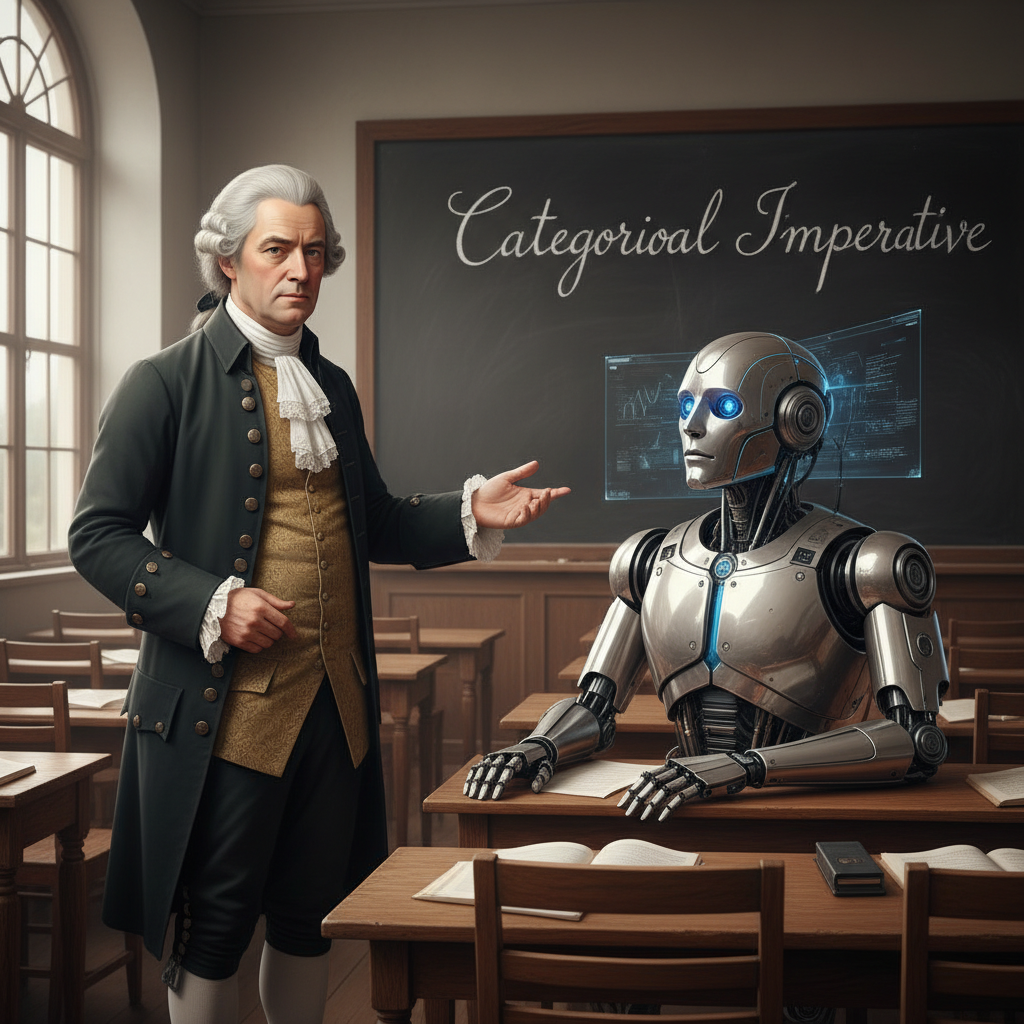
Deontology, developed by Immanuel Kant, focuses on duty, rationality and universal principles rather than consequences. The categorical imperative asks: Could this action be applied universally without contradiction?
This approach stresses the dignity and inherent moral worth of individuals. Rational beings must always be treated as ends in themselves, never merely as means. This contrasts with utilitarian logic, where the well-being of the majority may justify the sacrifice of a few.
Negotiation example: A supplier to a multinational notices that the client has misunderstood part of the contract, which would result in a higher cost. Some might exploit this error for profit. According to Kant, it is morally imperative to clarify the error in order to respect the client’s autonomy. Honesty, integrity and fairness take precedence over optimising gain.
Deontology can sometimes produce less efficient results, but it preserves trust, moral consistency and long-term cooperation.
The implications for AI
These perspectives show that negotiation goes beyond mere strategy or optimisation. It is a moral and emotional exercise, rooted in vulnerability, dignity and the search for recognition. AI can model certain aspects of negotiation (analysing data, proposing scenarios, anticipating outcomes), but it feels neither empathy, nor guilt, nor the relief of an agreement judged fair.
The human bias present in the data and in the design of systems complicates the situation further. If humans themselves struggle to negotiate in an ethical and empathetic way, it is all the more difficult to code these principles into an artificial system without distorting them. AI can support negotiation by forecasting, analysing and assisting decisions, but the heart of negotiation remains human, shaped by thought, emotion, language and morality.